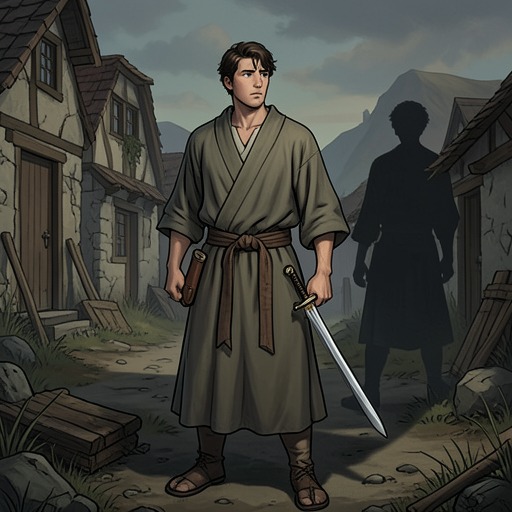
Izoku
5 Centimeters per SecondThe Izoku are a people of Agartha associated with danger, darkness, and the policing of boundaries between the underground world and the surface. Their significance lies not only in their attacks, but in the explanation attached to them: they oppose admixture and are described as one of the forces that keep the world from changing. The story’s scattered encounters recast them from unknown monsters into agents of a harsh social and cosmic order.
Identity and Recognition
Ryuuji Morisaki first identifies the Izoku through a gap in the Arch Angels’ knowledge. The organization knew that Agartha existed, but had little information about creatures in its interior: since photography was invented, no human visitor had returned from Agartha, while observations of the Quetzal Coatls on the surface could provide only limited data. Faced with gray creatures with shining red eyes and claws, Morisaki recalls the name Izoku and the fragmentary account that they oppose contact between the surface and Agartha.
That recognition remains provisional at first. Morisaki remembers that water and light are their weaknesses, but he cannot explain why they have singled out Asuna. The episode therefore separates identifying a creature from understanding its purpose: the Arch Angels’ research supplies a name and a few vulnerabilities, not a complete account of the Izoku or the rules governing their behavior.
Encounters and Behavior
During the attack, the creatures do not target Morisaki; they pursue Asuna instead. His gun has already proved ineffective, and the attackers’ selective attention makes the threat more puzzling than a simple assault on everyone present. After the group drives them back temporarily and runs down stairs, Shin identifies the place as an Izoku nest. He explains that the Izoku regard Asuna’s blood as defiled and want to devour her. The pursuit is thus presented as connected to her perceived lineage, although the available explanation does not establish precisely what the Izoku know about her.
A later encounter makes the threat recur rather than vanish with that escape. Asuna, absorbed in the thought that loneliness was why she had come to Agartha, is abruptly brought back to the present by breathing close beside her ear and recognizes an Izoku. The scene reconnects the creatures with the danger of Agartha even during a moment of inward reflection. It also gives their presence a disruptive narrative function: an immediate encounter cuts across Asuna’s attempt to understand her own feelings.
Admixture and the Order of Agartha
The old man gives the clearest account of what the Izoku represent. He describes them as a cursed race that abhors light and water, but also as one of the mechanisms that seek to keep the world as it is. Their hatred of admixtures follows from that function. This account broadens Morisaki’s earlier recollection: the Izoku are not merely dangerous inhabitants of Agartha but part of a system that resists the mingling of peoples and the alteration of established boundaries.
Manna’s history gives that principle a human consequence. Her father is a Topsider, a rare circumstance that makes her an admixture. After learning this, Asuna and Morisaki infer that Manna was deliberately placed where the Izoku might appear, so that others could see whether she would return home safely. The old man neither confirms nor denies their interpretation; he leaves the room instead. The uncertainty matters: the test’s purpose is stated by Asuna and Morisaki as an inference, while the old man’s response provides no explicit confirmation. Even so, the possibility that Manna’s safety was used to test whether the world would permit her existence makes the Izoku’s role more than a matter of physical danger. Their hostility becomes a measure by which Agartha’s inhabitants judge the viability of a mixed lineage.
Narrative Significance
The Izoku’s description holds two ideas in tension. Characters speak of a tribe or race with recognizable traits and weaknesses, yet the old man also calls them a mechanism preserving the world’s existing order. The narrative does not resolve that tension into a detailed natural history. Instead, it lets the limited knowledge surrounding them echo the limits of human understanding of Agartha: the Arch Angels have incomplete research, Morisaki has only a remembered account, and Shin and the old man provide explanations grounded in different encounters.
Their repeated attention to people associated with admixture links individual peril to Agartha’s larger boundary between surface and interior. Asuna is pursued, while Manna’s mixed parentage is revealed as the reason her safety became a test. These episodes do not establish that the two girls share the same circumstances; rather, they show how the Izoku’s opposition to mixing shapes the danger surrounding both. In that way, the Izoku make an abstract resistance to change concrete. They are frightening as pursuers, but their deeper narrative force comes from what their presence exposes: a world where belonging across the divide is treated as a threat to the order itself.